
How It Works
Two Types of Subscription-Based Telemetry Systems: What's the Difference?
Telemetry sounds technical, but the idea behind it is simple — and understanding it is the key to choosing a safety system that matches how your people actually work. There are two fundamentally different ways a device gets its data to the cloud, and each one is built for a different kind of operation.
If you're responsible for the safety of people who work alone, in the field, in confined spaces, or in hazardous environments, you've probably run into the word "telemetry." It sounds technical, but the idea behind it is simple.
Understanding it is the key to choosing the right safety system — one that protects workers according to how your people actually work.
Telemetry, in plain terms
Telemetry is the automatic collection and transmission of data by wireless RF (radio-frequency) means, from a device in the field to a place where someone can see it and act on it. In the safety world, that "data" is the information that keeps a worker accounted for:
- Are they checked in?
- Have they moved recently?
- Did a fall or no-motion event just trigger an alarm?
- Did someone press the SOS button?
- Where are they located?
A safety system contains a device gathering those inputs, and uses telemetry to carry the information — in near real time — back to a monitoring platform where a supervisor, dispatcher, safety officer, or incident commander can respond. Without telemetry, a device can only alert the people standing next to it. With telemetry, a distress signal can reach help that's miles or even thousands of miles away.
At Grace Industries, that monitoring platform is Grace Cloud Connect® — a web portal and smartphone app that shows worker status, check-ins, locations, and alerts. The important part to understand is that how a device gets its data to that platform isn't the same across our product lines. There are two fundamentally different approaches, each built for a different kind of operation.
Approach one: every device is its own connection
The first approach puts a full cellular connection inside each device. The Grace MicroCELL® works this way. Each MicroCELL® is, in effect, its own cellphone — it has a 4G LTE cellular radio with GPS and Wi-Fi built in, and it talks directly to Grace Cloud Connect® over the cellular network. Because of that, every MicroCELL® has its own cellular plan, voice or data, the same way every phone on your family plan needs its own line and unique number.
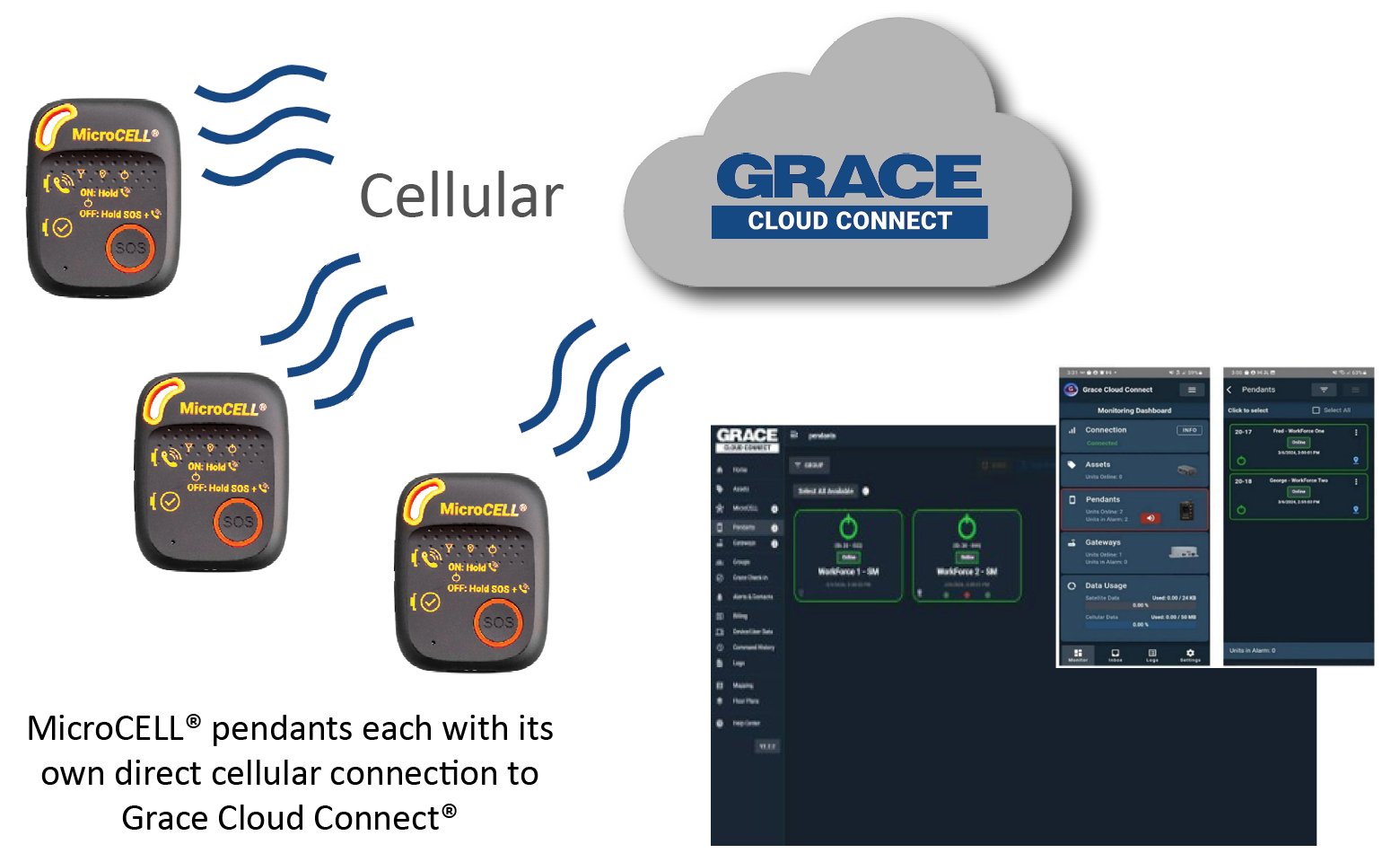
That "one device, one connection" design is exactly what you want when your people don't share a location. Think of a gas pipeline inspector who covers a different stretch of right-of-way every day, a visiting home healthcare nurse moving between patients' homes, or a code-enforcement officer driving from site to site. There's no fixed base to tie back to — the worker is the mobile unit.
Because each MicroCELL® carries its own connection, it stays covered wherever there's cellular service, with no dependence on being near any other equipment. The primary advantage: every worker has their own connection.
Approach two: one connection serves many devices
The second approach shares the connection among multiple safety devices. Instead of building cellular into every worker's device, a single "gateway" provides the link for internet connectivity, and all worker safety devices on site connect through it.
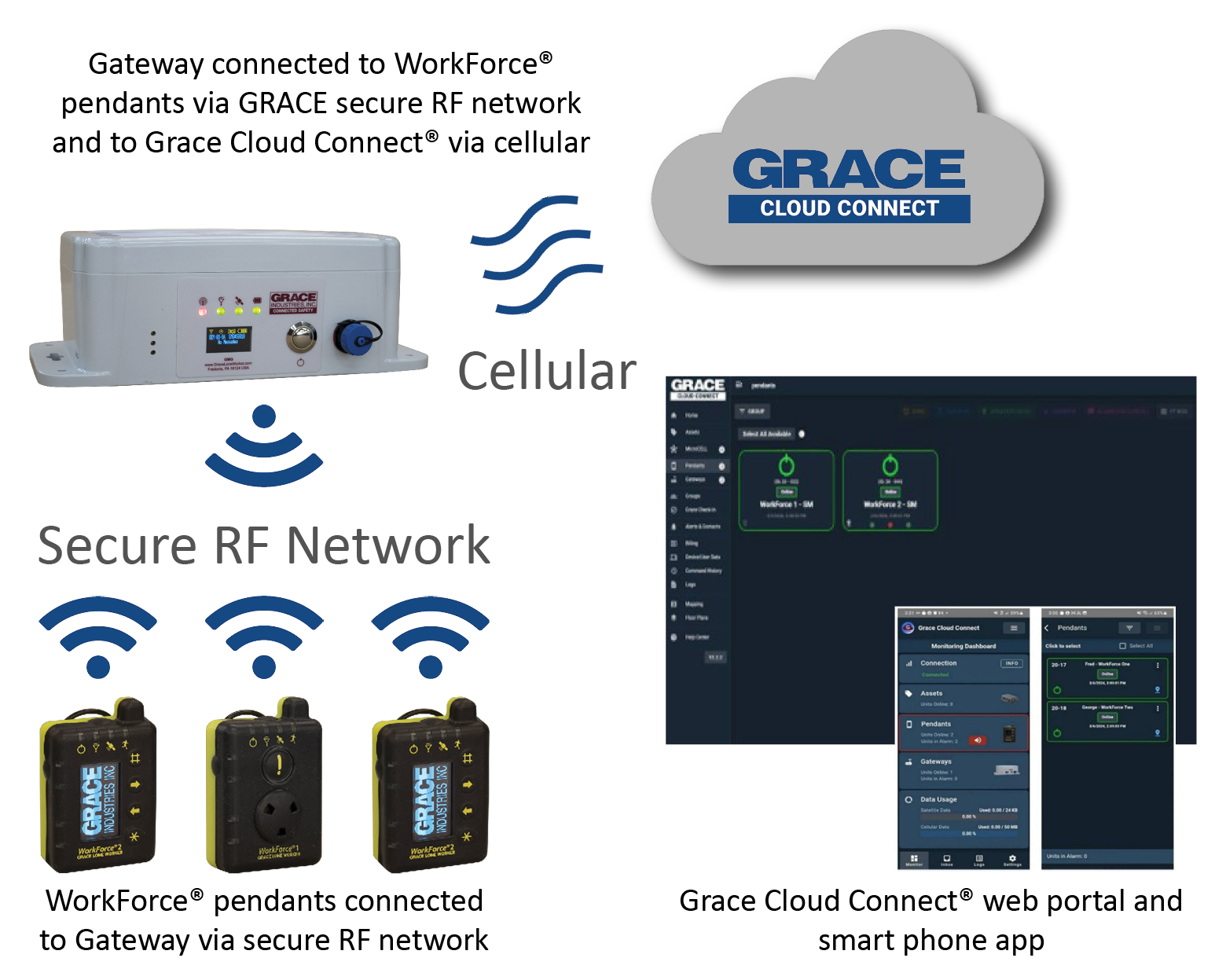
The primary advantage is efficiency at a fixed site. One gateway can support many worker-worn pendants — up to a hundred or more. A single gateway connection covers the whole crew rather than one connection per person. That's ideal for fixed-location operations such as a water or wastewater treatment plant, a cold-storage warehouse, a manufacturing floor, or an active fireground where the whole team is working the same area.
A secondary advantage: on-site coworkers can also directly receive alerts about a coworker in distress. That differs from the first approach, where the pipeline inspector or the visiting nurse is connected directly to the cloud on their own.
Under the hood: how the gateway link works
Several Grace Industries products function as gateways — the GFG, GMG, MS3000X, and PWA. Gateways use one or more connectivity methods including Wi-Fi, Ethernet, cellular, or a satellite uplink, some with redundancy, to connect to Grace Cloud Connect®. On the worker-worn pendant side, each pendant uses a high-performance frequency-hopping, spread-spectrum RF transceiver to communicate with the gateway. The pendant signals the gateway over that RF telemetry link, and the gateway relays everything to the cloud via its internet connection.
100+
Worker-worn pendants a single gateway can support
1 mile
Typical gateway-to-pendant range, line of sight — reduced inside buildings with obstructions
~200,000 sq. ft.
Typical indoor coverage, varying with building contents, construction materials, and environment. A variety of repeater options are available to expand range and coverage as needed.
4
Grace products that act as gateways — GFG, GMG, MS3000X, and PWA — with repeater options to expand range
Same goal, different architecture
Both approaches deliver the same outcome through Grace Cloud Connect®: near real-time visibility, automatic alerts, and a data-logged record of what happened. The difference is the path the data takes to get there.
| Approach one | Approach two | |
|---|---|---|
| Connection lives in | Each device | A shared gateway |
| Device | MicroCELL® | WorkForce® pendants + gateway |
| Link to the cloud | 4G LTE cellular, with GPS and Wi-Fi on board | Spread-spectrum RF to the gateway, then Wi-Fi, Ethernet, cellular, or satellite |
| Best for | Workers spread across different sites every day | Multiple workers operating within a defined area |
| Coverage depends on | Cellular service wherever the worker goes | RF range of the gateway, extendable with repeaters |
| Alerts reach | Grace Cloud Connect® and designated responders | Grace Cloud Connect®, designated responders, and on-site coworkers |
Which one fits your operation
Making the best choice comes down to a single question: are your workers sharing a common work location, or not?
If your workers spread out to different sites every day, per-device cellular — the MicroCELL® — is the better choice, and keeps each of them independently connected wherever they go. If multiple workers operate together within a defined area, a gateway plus RF worker-worn pendants such as WorkForce® provide the same protection more efficiently, with a single shared gateway connection carrying the whole team.
Understanding that distinction is what turns a list of products into a system that actually fits how your people work. In future posts, we'll dig into the individual devices, real-world deployments, and how best to size a worker safety solution for your operation.
Grace Industries designs and manufactures worker-safety and firefighter emergency signaling solutions backed by Grace Cloud Connect®. To explore the right fit for your operation, visit graceindustries.com, email sales@graceindustries.com, or call 1-724-962-9231.
Next step
Not sure which architecture fits your operation?
Tell us how your people are distributed — one site or fifty — and we'll walk through whether per-device cellular or a shared gateway is the better fit, and what the deployment would look like. No obligation.