
Fire Investigation
Accelerant Detection in Fire Investigation: What a Field Instrument Can and Cannot Tell You
How hydrocarbon detectors fit into a defensible fire investigation, how they compare to accelerant canines and laboratory GC-MS, and an honest look at what else is on the market alongside the Grace 950-ASH-D.
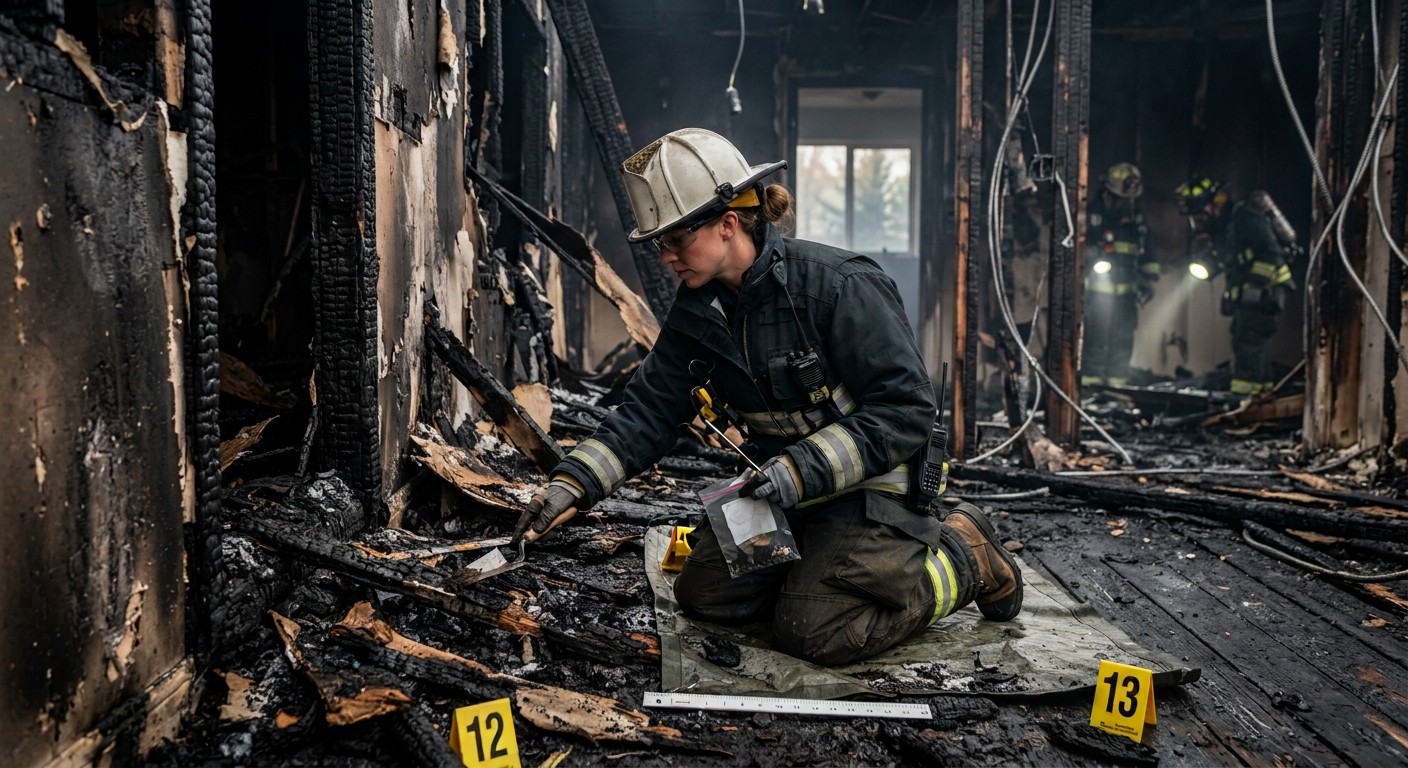
Walk onto a fire scene with a hydrocarbon detector and it will start telling you things. The trick — the thing that separates an investigation that holds up from one that gets excluded — is knowing exactly what those things are, and what they are not.
This is a guide to where a portable accelerant detector actually belongs in a fire investigation, what the standards say about it, how it stacks up against a canine and against the laboratory, and what else is on the market.
Start with what NFPA 921 says the instrument is for
NFPA 921, Guide for Fire and Explosion Investigations, defines a combustible gas indicator in one sentence, and the verb is the whole story:
“An instrument that samples air and indicates whether there are ignitable vapors or gases present.”
Indicates whether present. It does not identify. It does not quantify for evidentiary purposes. It does not classify.
That’s not a limitation the manufacturer is admitting to reluctantly — it is the instrument’s assigned job. A field detector is a screening tool. Its purpose is to help you decide where to take a sample, out of a scene that might offer a hundred plausible locations and a budget for six.
Everyone in the chain says the same thing. Field screening tools direct sample collection decisions; they do not identify what is present. Even PID manufacturers frame their own instruments this way in arson application notes: once the instrument detects a target vapor, a sample of that air can be collected and sent to a lab for verification.
The reason is chemical, not commercial. A field detector responds to hydrocarbons generically, and it cannot distinguish an ignitable liquid from the pyrolysis products of ordinary furnishings. Burning carpet, foam, adhesives and plastics all produce hydrocarbons. A detector that alerts on gasoline will also alert on a melted couch. It is “susceptible to false positive alerts on pyrolysis items that are already saturated with a hydrocarbon base.”
What actually confirms an ignitable liquid
The laboratory does, under ASTM E1618-25, Standard Test Method for Identification of Ignitable Liquids in Fire Debris Analysis by Gas Chromatography-Mass Spectrometry.
Samples reach that test through a supporting family of ASTM methods — most commonly E1412, passive headspace concentration with activated charcoal — and modern labs are sensitive. One USFA analysis puts it memorably: laboratories today can detect 0.1 µl — about 1/500 of a drop — of ignitable liquid in a gallon of fire debris without difficulty.
The language on the report matters too, and it’s worth training newer investigators on:
- “Consistent with gasoline” — the chemical profile matches the expected components
- “Gasoline detected” — positive identification
- “Possible petroleum distillate” — degradation or interference is limiting the call
None of those phrases can be produced by anything you carry on your belt.
Where accelerant canines fit — and the problem nobody has solved
Accelerant detection canines are extraordinarily sensitive. Published comparisons put ADC detection of 50%-evaporated gasoline at around 0.01 µL, against roughly 0.25 µL for the gas chromatograph in the same comparison. A 2022 study in Frontiers in Analytical Science estimated the minimum detectable quantity for an ignitable-liquid detection canine under fire-scene-like conditions at approximately 50 picoliters of evaporated gasoline, against 1–0.1 µL for standard analytical methods.
Read that again, because it creates the central problem of the discipline: a good dog can smell things the laboratory cannot confirm.
And what a dog has in sensitivity, it lacks in specificity. NFPA 921 warns that dogs respond to pyrolysis products not produced by an ignitable liquid — the same false-positive mechanism that affects electronic detectors — and may miss actual accelerants. Handlers also contend with olfactory fatigue, distraction, maintenance cost, and bonding to a single handler.
NFPA 921’s rule is unambiguous:
“In order for the presence or absence of an ignitable liquid to be scientifically confirmed in a sample, that sample should be analyzed by a laboratory. Any canine alert not confirmed by laboratory analysis should not be considered validated.”
The Canine Accelerant Detection Association goes further, instructing that handlers “should never testify or encourage testimony that an ignitable liquid is present without confirmation through laboratory analysis.”
And yet unconfirmed alerts have been admitted in court, and researchers describe “a dangerous situation where some canine handlers have taken their canine indications to court without proper laboratory confirmation due to frustration over negative laboratory findings.” In U.S. v. Myers, handler testimony on canine alerts failed a Daubert challenge when laboratory testing produced negative results contradicting the alert.
There’s an underappreciated implication here for electronic screening. An instrument is less sensitive than a canine but within the range the laboratory can confirm. Frustrating as that sounds, it means an electronic screener is less likely to send you chasing residues the lab can never validate — and less likely to produce the exact evidentiary trap the canine case law is full of.
What else is on the market
The purpose-built category is thin, and it has been shrinking.
Arrowhead Forensics, the largest U.S. forensic-supply catalog for fire and explosion investigation, carries evidence bags, seals, charcoal strips and a sifting shovel, and no detection instruments at all. The KWJ “Fire Arson Detector Model 626 Trooper 2,” profiled in the trade press in 2014, has disappeared from its manufacturer’s current catalog. Sirchie’s CGD8800A shows as no longer available. The classic Century Systems / Foxboro OVA organic vapor analyzer survives only on the secondhand market, with no production successor marketed to fire investigation.
What’s left divides into three tiers.
Tier 1 — utility and HVAC leak detectors, under $700. Semiconductor sensors, minimal documentation features, mostly not designed for scene work.
Tier 2 — field instruments, roughly $1,000–$1,800. This is where the Grace 950-ASH-D sits, alongside the Sensit HXG-3 series.
Tier 3 — PID, FID and portable GC instruments, $5,000–$38,000. Quantitative, calibrated, consumable-dependent, and generally bought by environmental, industrial hygiene or hazmat programs that also happen to do fire work.
| Instrument | Sensor type | Sensitivity | Calibration | Consumables | Approx. price |
|---|---|---|---|---|---|
| Grace 950-ASH-D | Solid-state metal oxide semiconductor | Relative — see below | None required | None | $1,885 |
| Sirchie CGD100A | Solid-state semiconductor | <50 ppm methane | Not stated | 9V rechargeable | $495 |
| TIF 8800X | Solid-state semiconductor | 1 ppm gasoline vapor | Not stated | NiMH pack | $392–652 |
| Sensit HXG-2d | Metal oxide | 0–990 ppm / 0–100% LEL | Field cal capable | C cells | $600 |
| Sensit HXG-3 | Metal oxide | 0–50,000 ppm | Cal kit optional; $90 service | C cells | $1,082–1,532 |
| Honeywell MiniRAE 3000+ | PID, 10.6 eV | 0.1 ppm res. to 15,000 ppm | Yes — 2/3-point | Lamps $171–590; sensor $303; cal gas $58–128 | ~$5,121 |
| Ion Science Tiger XT | PID, 10.6 eV | 1 ppb – 20,000 ppm | Yes | Lamps, filters | Quote |
| Dräger X-pid 9500 | GC + PID | Benzene from 50 ppb | Yes | None for measurement | $38,337 |
| Thermo TVA2020 | FID (+ optional PID) | MDL 0.5 ppm | Yes | Hydrogen fuel | Quote |
| INFICON MicroFID II | FID | 0.1–50,000 ppm | Yes | Hydrogen cylinder | Quote |
Prices are retail listings captured August 2026 and move; several vendors quote only on request.
Why one column in that table reads differently
Look at the sensitivity column and the 950-ASH-D is the odd one out. That is not a missing specification — it is a different class of instrument, and the distinction is worth understanding before you compare anything.
A PID or FID reports an absolute concentration: this air contains n parts per million of something, measured against a certified standard the instrument was calibrated to. That number means the same thing on Tuesday as it did on Monday, in your scene as in someone else’s.
The 950-ASH-D reports a relative concentration. Its sensor’s resistance changes in the presence of hydrocarbon vapor, and the instrument converts that change into an audio and visual rate signal proportional to the relative concentration of hydrocarbons present. The operator sets the baseline manually before every use — rotate the detection range control until the LEDs stop flashing and the reading is in the 0–2 region — and then works outward from there.
Two things follow, and they’re the same fact wearing different hats:
There is no ppm threshold to publish, because the instrument never claims an absolute number. It answers more here than there, which is the question sample selection actually asks.
There is nothing to calibrate against, because there is no absolute scale to drift away from of the actual hydrocarbon being detected. Calibration is the act of pinning an instrument’s readings to a certified reference; an instrument that reports relative change has no reference to pin and provides the unique advantage of detecting trace levels of stronger concentrations of suspect hydrocarbons.
Neither is a limitation being explained away. They are the design, and they’re the reason the maintenance column reads the way it does.
One instrument you’ll see recommended in gas-detection roundups that does not belong on a fire scene: the Heath DP-IR+ is deliberately methane-selective, “capable of detecting methane without false alarming on other gases.” That’s exactly backwards from what accelerant screening needs.
The calibration question
Instruments that produce a quantitative reading have to be calibrated against a certified gas standard, and the maintenance burden is not trivial.
PID lamps foul. Manufacturers specify cleaning every 100 hours of normal use, and as often as every 20 hours in heavily contaminated environments. Cleaning requires a kit — polishing compound, stack removal tool, cotton buds, compressed air, ESD protection. A pitted or cracked lamp can’t be cleaned at all; it gets replaced at $171–$590. PIDs are also degraded by humidity, with signal quenching and transients at high relative humidity. A fire scene after suppression is saturated, particulate-laden and warm — close to a worst case for a PID lamp.
Catalytic bead sensors are worse in a different way. They are permanently poisoned by silicones (including ordinary lotions and hair products), lubricants, lead and sulfur compounds, and inhibited by halogenated compounds. A poisoned bead fails calibration afterward — and in the meantime it is a silent blind spot. Catalytic beads also don’t function below about 10% oxygen and read in %LEL rather than ppm, so they can’t see the trace concentrations accelerant screening is looking for at all.
Published intervals run from daily bump testing before use (Honeywell, MSA, RKI, Industrial Scientific all specify this) to full calibration every 30 days for PID VOC sensors per RKI, or every 90–180 days for other sensor types.
What it costs to run a calibrated instrument: roughly $5,100 for a MiniRAE 3000, plus a $695 calibration kit, plus $58–128 per cylinder of 100 ppm isobutylene with a 36-month shelf life, plus a $135–335 regulator — about $6,000 before you attend a single scene — with recurring gas, lamp and service costs after that.
And the trade-off, both directions:
What a calibrated PID gives you that a relative-response screener does not: quantitative ppm readings with a documented, traceable relationship to a certified standard. That number goes in a report, survives cross-examination on instrument accuracy, and — importantly — supports scene safety and industrial hygiene decisions about exposure and respiratory protection that a relative indication cannot. A calibration certificate is also a materially stronger answer on the stand than “the meter beeped faster over there.”
What a relative-response screener gives you: no span gas inventory expiring unused in a drawer, no bump-test discipline to maintain, no lamp-cleaning kit, no annual service cycle. For a part-time or volunteer investigator working three fires a year, that maintenance burden is chronically unmet in practice — cylinders expire, bump tests get skipped, and the instrument arrives at the scene in an undocumented state, which is arguably a worse evidentiary posture than an instrument that never claimed a quantitative reading. A broad-response semiconductor also detects methane and natural gas, which a standard 10.6 eV PID cannot see at all — so one instrument covers both accelerant screening and the fuel-gas systems NFPA 1033 requires an investigator to understand.
The point worth making, and it’s the defensible one: for the job NFPA 921 assigns to a field instrument — deciding where to take a sample — quantification adds nothing. The lab determines whether an ignitable liquid is present. A relative indication that here is stronger than there is exactly the information needed to satisfy NFPA 1033 §4.4.3, Select Evidence for Analysis.
Where the 950-ASH-D sits: it is a relative-response instrument and requires no calibration — no span gas, no bump-test schedule, no calibration interval, no return-to-factory cycle. Its documented maintenance is cleaning, correct storage, and eventual long-term sensor replacement, and the sensor is user-removable and user-replaceable in the field.
What you do instead, every single use, is set the baseline. That takes about a minute after warmup and it is not optional — an instrument used without establishing its baseline is an instrument whose readings mean nothing. It replaces the calibration discipline rather than eliminating discipline altogether, and it has the advantage of being performed at the scene, on the day, by the person whose findings depend on it.
On UV light: useful, but be careful what you claim
Many field detectors, including the 950-ASH-D, carry UV and white LED illumination at the probe tip — in the 950-ASH-D’s case, eight 395nm long-wave UV LEDs and eight white LEDs arrayed around the sensor. Used well, that’s a real advantage — it lights dark voids, undersides of debris and charred surfaces, and on favorable substrates some residues fluoresce.
But the evidence for UV as a detection method at fire scenes is thin, and it’s worth saying so. NFPA 921’s physical evidence chapter has no section on ultraviolet light, fluorescence or alternate light sources. NIJ’s practitioner guide, Fire and Arson Scene Evidence, doesn’t mention UV at all. The demonstrations that do exist were run on clean substrates like white fabric — and a fire scene is charred wood, soot and melted synthetics, a background that both absorbs UV and fluoresces on its own. The fact that researchers have built time-resolved laser-induced fluorescence and hyperspectral imaging systems specifically to solve this problem is itself evidence that a handheld UV LED has not.
Treat UV as scene lighting and visualization that helps you decide where to sample. Do not treat a fluorescence response as evidence of anything.
Documenting it defensibly
- Record the instrument reading — location, relative response, make, model, serial number, date, operator, maintenance state. It is part of the investigative record and evidence that a systematic search was conducted.
- Use it to select samples. That is the NFPA 1033 §4.4.3 job.
- Never testify that the instrument established the presence of an ignitable liquid. Only GC-MS analysis under ASTM E1618 does that.
- If the lab comes back negative, the field indication is not validated — the same rule NFPA 921 applies to canine alerts.
An instrument that never claims a quantitative result cannot be impeached on quantification. Its evidentiary role is to show why you sampled there — a methodology question, not a measurement question. Overclaiming what a field instrument establishes is what gets testimony excluded. A screener used and described as a screener is on firm ground.
Frequently asked questions
Can a hydrocarbon detector prove arson?
No. A field detector indicates that ignitable vapors may be present at a location. Confirmation that an ignitable liquid residue exists in a sample requires laboratory GC-MS analysis under ASTM E1618. And determining that a fire was incendiary is a separate origin-and-cause conclusion that no instrument produces.
How does a detector compare to an accelerant detection canine?
A canine is dramatically more sensitive — published estimates put ADC detection at levels below what standard laboratory methods can confirm. But canines share the electronic detector’s specificity problem: both alert on pyrolysis products from ordinary burned materials. NFPA 921 requires laboratory confirmation for either. Many investigators use both, and many departments have access to neither on short notice.
Do I have to calibrate a hydrocarbon detector?
It depends entirely on what class of instrument it is. PID, FID and catalytic-bead instruments report quantitative ppm values against a certified reference, so they require regular calibration, daily bump testing and consumables. A relative-response instrument like the Grace 950-ASH-D reports comparative concentration rather than an absolute number, so there is no reference to calibrate against and no calibration required — what it needs instead is a baseline set by the operator with each use. Follow your specific manufacturer’s published instructions either way, and document whatever maintenance you perform, because that record is part of your investigative file.
Why doesn’t the 950-ASH-D publish a ppm sensitivity figure?
Because it doesn’t measure in ppm. It reports relative concentration — the audio and visual rate signal is proportional to how much hydrocarbon vapor is present compared to the baseline the operator set at the start of the scene. A ppm figure would describe a different class of instrument. For sample selection, which is the job NFPA 921 assigns to a field detector, relative response is the information you actually need.
Why can my detector alert where there’s no accelerant?
Because burning household materials produce hydrocarbons. Carpet, foam, adhesives, plastics and synthetic fabrics all yield pyrolysis products a hydrocarbon-responsive sensor will detect. This is the fundamental reason a field instrument is a screening tool rather than a confirmatory one, and the reason laboratory analysis exists.
Does UV light find accelerants?
UV illumination helps you see — into voids, under debris, along charred surfaces — and on favorable substrates some residues fluoresce. It is a visualization aid that supports sample selection. It is not a detection method, and a fluorescence response is not evidence that an ignitable liquid is present.
What should I document when I use a field detector?
The location of each reading, the relative response observed, the instrument’s make, model and serial number, the date and operator, and the instrument’s maintenance state. The value of the record is that it shows a systematic search was conducted and explains why particular samples were collected.
This article is general information. It was drafted with the assistance of AI which can make mistakes.
Grace Industries has been supporting fire investigators for over 50 years. The Model 950-ASH-D Arson Scanner and Accelerant Detector is a rugged, field-ready screening instrument built around a solid-state metal oxide semiconductor sensor: a telescoping probe extending to 45 inches, eight 395nm UV and eight white LEDs at the sensor head, high and low detection ranges, a purge function for rapid sensor recovery, mute mode for discreet work, and a user-replaceable sensor. No calibration required.
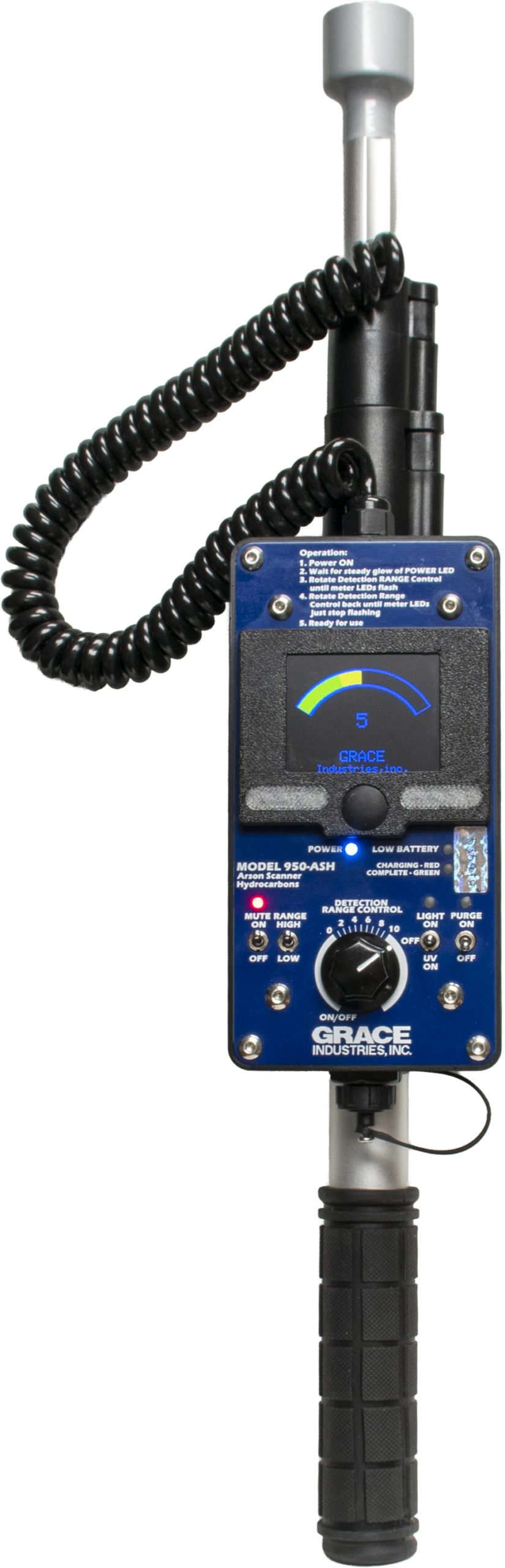
To learn more or find your nearest distributor, visit graceindustries.com/arson-investigation/ or contact us at 1-724-962-9231 or sales@graceindustries.com.
Next step
Equipping your fire investigation unit?
We can help you find a screening instrument that fits how your investigators work, and point you to your nearest distributor — no obligation.