
Standards & Compliance
NFPA 1970: What Changed for PASS Devices — and What It Means for Your Department
NFPA 1982 is gone, folded into NFPA 1970 (2025 ed.). Here’s what section 22.5 actually changed for standalone and integrated PASS, why intrinsic safety is now optional, the interconnection restriction almost nobody is talking about, and whether your department has to replace anything.
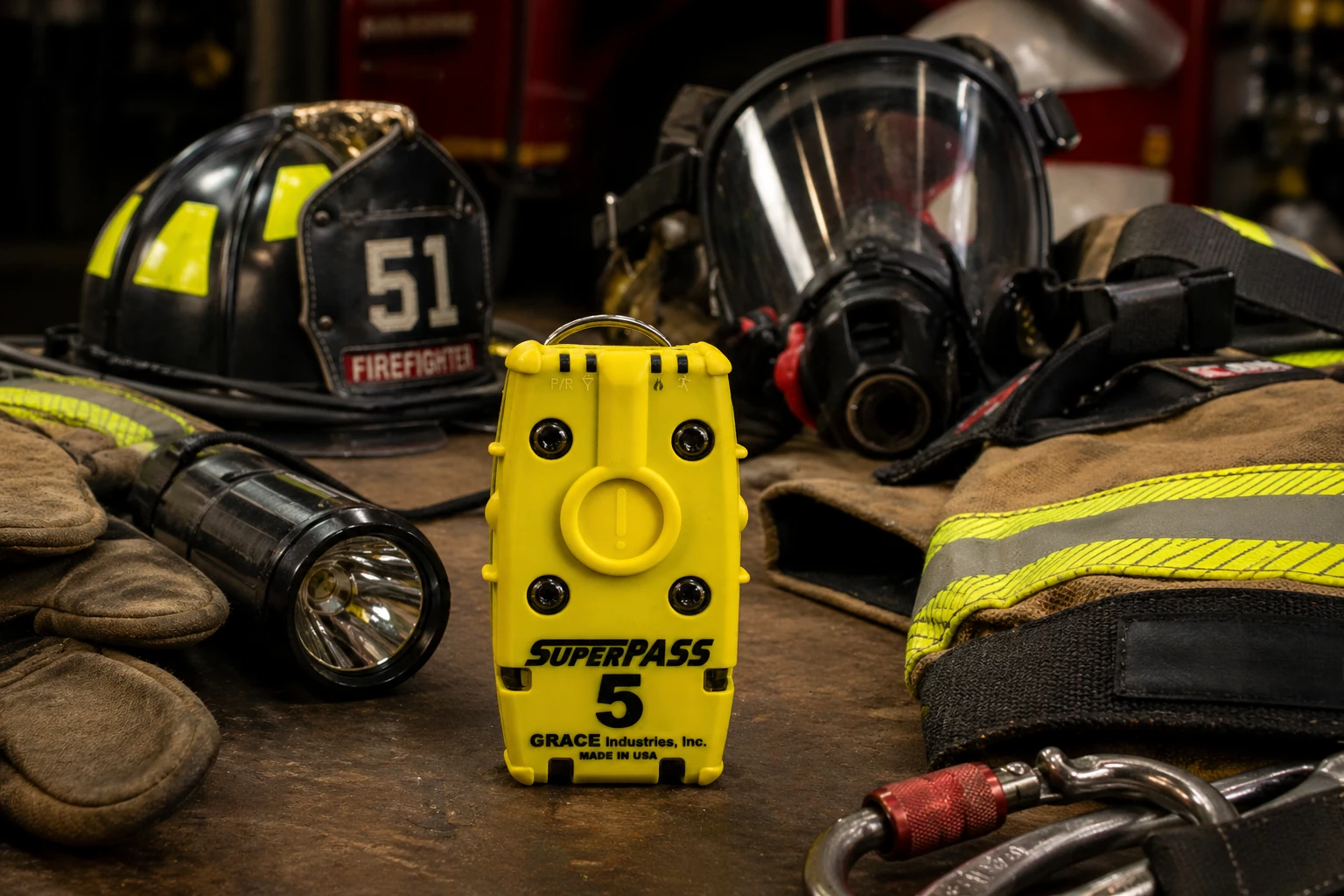
If you’ve gone looking for NFPA 1982 lately, you won’t find it as a standalone document anymore. The PASS standard has been folded into a much larger combined standard, and the change has left a lot of departments with the same two questions.
What actually changed for PASS devices? And do I have to buy anything?
The short answers: less than the headline suggests, and no. But the details matter, particularly if you’re writing a purchase specification or building a grant application this year.
What happened: four standards became one
NFPA 1970 was issued by the NFPA Standards Council on August 29, 2024, with an effective date of September 18, 2024. Its full title tells you everything it swallowed: Standard on Protective Ensembles for Structural and Proximity Firefighting, Work Apparel, Open-Circuit Self-Contained Breathing Apparatus (SCBA) for Emergency Services, and Personal Alert Safety Systems (PASS).
Four former standards now live inside it:
| Former standard | Covered | Now in NFPA 1970 |
|---|---|---|
| NFPA 1971 | Structural and proximity protective ensembles | Chapters 5–9 |
| NFPA 1975 | Station and work apparel | Chapters 10–14 |
| NFPA 1981 | Open-circuit SCBA | Chapters 15–19 |
| NFPA 1982 | PASS | Chapters 20–24 |
Chapters 1–4 carry the common administration, referenced publications, definitions and certification requirements that all four product families now share.
This wasn’t a PASS-specific decision. It’s one piece of NFPA’s Emergency Response and Responder Safety consolidation project, launched in 2020, which is collapsing 114 emergency-responder standards, guides and recommended practices into 38. NFPA’s stated reasons were practical: responders and committee members reported conflicting requirements between standards, committees weren’t aware of each other’s work, and it had become impossible to staff that many technical committees properly.
So the reorganization was largely structural. Which is exactly why the next question is the important one.
What actually changed for PASS
The performance test battery survived essentially intact
If you compare the two editions section by section, the tests a PASS has to pass are the same tests, renumbered. Sound pressure, electronic temperature stress, corrosion resistance, immersion leakage, case integrity, shock sensitivity, impact and vibration, retention system, water drainage, heat resistance, heat and flame, product label durability, and the alarm signal muffle test all carried forward from NFPA 1982 Chapter 7 into NFPA 1970 Chapter 23.
The five RF PASS radio system tests added or refined in the 2018 edition — point-to-point RF attenuation, loss-of-signal, RF interference, multipath, and multi-hop — all survive as well, at sections 23.14 through 23.18. That matters for telemetry-capable devices: RF PASS remains a fully recognized, fully tested category under the new standard, not an afterthought.
One genuine consolidation: NFPA 1982 (2018) carried two separate signal frequency tests. NFPA 1970 merges them into a single 24.14 Prealarm and Alarm Signal Frequency Test.
The real change is in hazardous-location certification
This is the one substantive technical shift, and it’s easy to miss.
NFPA 1982 (2018) treated intrinsic safety as a performance requirement at section 7.6, referencing a single standard: ANSI/UL 913, for Class I, Groups C and D and Class II, Groups E, F and G, Division 1 hazardous locations.
NFPA 1970 removes that performance section and replaces it with a design requirement — 22.5, Hazardous Location Requirements — written around four permitted types of explosion protection, and referencing two standards instead of one.
22.5.2.1 sets the floor. PASS devices and accessories involving electrical circuitry shall, at a minimum, be suitable for use in Class I, Division 2, Groups C and D; Class II, Division 2, Groups F and G; and Class III, Divisions 1 and 2, with a temperature class in the range T3 through T6, in accordance with UL 121201, the non-incendive equipment standard.
22.5.3.1 makes intrinsic safety optional. Devices “shall be permitted to be certified” for use in Class I, Division 1, Groups C and D; Class II, Division 1, Groups E, F and G, in the same T3–T6 range, in accordance with UL 913.
The operative language
Read those two together and the change is unambiguous. Shall, at a minimum versus shall be permitted to. The Division 2 non-incendive certification is the requirement. Division 1 intrinsic safety is now an option a manufacturer may choose.
Two details are worth noticing while you’re in there. The Division 1 intrinsic-safety option preserves exactly the group coverage NFPA 1982 required — Class I Groups C and D, Class II Groups E, F and G — so a device certified to it is where the fleet used to be. The Division 2 minimum does not include Group E, the metallic dust group, which is consistent with how Class II Division 2 is treated generally but means the two paths are not equivalent coverage.
For a purchasing officer, the takeaway is simple: “NFPA 1970 compliant” and “intrinsically safe to UL 913” are no longer the same claim. If intrinsic safety to Division 1 matters for your operations — and for interior structural firefighting in unknown atmospheres, most departments would say it does — ask the manufacturer to state it explicitly, in writing, rather than assuming it is bundled into the compliance label. It is now entirely possible for a device to be fully NFPA 1970 compliant and certified only to the Division 2 non-incendive minimum.
The provision almost nobody is talking about: interconnection is now locked to the certified system
This is the part of 22.5 with the biggest practical consequences, and it has had almost no attention.
Section 22.5.1 permits four types of explosion protection, and they divide along a line the standard itself draws:
| Type | Certification basis | Interconnection |
|---|---|---|
| Nonincendive equipment, stand-alone type | Individually certified, Class I and II Division 2 and Class III | No external electrical interconnection means |
| Nonincendive system | Multiple pieces certified together | Interconnected, dedicated system use |
| Intrinsically safe apparatus, stand-alone type | Individually certified, Class I and II Division 1 and Class III | No external electrical interconnection means |
| Intrinsically safe system | Multiple pieces certified together | Interconnected, dedicated system use |
And then 22.5.2.2 and 22.5.3.2 impose the same restriction on both system types. A PASS device certified as part of a system “shall only be interconnected with PASS device accessories also certified as part of the same” system — the standard’s own example being “specific PASS devices that are certified together with specific SCBAs as part of a single system.”
That sentence writes the system boundary into the certification itself, and it has real operational consequences for anyone running an integrated or electrically interconnected PASS:
- The certification attaches to the combination, not the component. A PASS certified together with a specific SCBA is compliant in that pairing. It is not a separately certified PASS you can move.
- Mixing is out. You cannot interconnect a system-certified PASS with accessories from a different certified system, even if both are individually NFPA 1970 compliant.
- Changing SCBA platforms is a bigger decision than it looks. If the pack changes, the certified pairing changes with it.
A stand-alone PASS sits outside all of this by definition. Types (1) and (3) are certified individually, “without any external electrical interconnection means, and intended for stand-alone use.” There is no combination to manage, no pairing to preserve, and no constraint on which air pack the firefighter happens to be wearing, because the device doesn’t electrically connect to it at all.
If you take one thing from 22.5 into a purchase specification, take this: ask whether a device is certified stand-alone or as part of a system, and if it’s a system, ask exactly which components are in it.
Standalone, integrated, and RF PASS all remain recognized categories
None of the above narrows the field. NFPA 1970 retains the RF PASS terminology throughout its definitions and its radio-system test sections, and continues to define evacuation alarms and loss-of-signal alarms transmitted between a base station and an RF PASS.
A standalone PASS is as compliant under NFPA 1970 as it was under NFPA 1982. So is an integrated unit. So is a telemetry-enabled RF device. The standard tests them all. It does not rank them. It just now asks a harder question about how they are wired together.
What this means for your department
You do not have to replace anything
This is the part most departments actually need to hear.
The consolidation constrains new certification, not existing equipment. No new product can be certified to the superseded editions, and new products must be certified to NFPA 1970. But nothing in the standard sets a date by which a department must stop using a PASS that was certified to NFPA 1982.
NFPA 1970 also explicitly permits retrofit components to be certified to earlier editions, which is the standard signaling that it does not intend to orphan fleets in service.
The model is purchase-forward. New buys meet the new edition. Equipment already in service keeps working until it fails inspection, fails a functional test, or reaches the end of the service life your manufacturer specifies.
Texas puts this in regulation in about the clearest language you will find anywhere: its fire protection rules require compliance with “the standard in effect at the time the entity contracts for new, rebuilt, repaired, or used PASS devices.”
The deadline that does exist is a manufacturer deadline
UL Solutions, the certification body, set two transition timelines after the effective date: a 12-month implementation period for ensembles and station wear, and an 18-month grace period for SCBA and PASS.
Eighteen months from September 18, 2024 is March 18, 2026, the last ship date for PASS certified to NFPA 1982 (2018). After that, manufacturers must remove certification and product labels indicating 2018-edition compliance, with verification by the certification organization.
That date has passed. What it means for you: anything you buy new today should carry an NFPA 1970 (2025 ed.) label. If a distributor is offering you 2018-labeled stock, ask questions.
There is no NFPA-mandated retirement age for PASS
Worth stating plainly, because it comes up constantly in budget meetings.
The care-and-maintenance side of the consolidation is NFPA 1850, which merged NFPA 1851 (turnout gear) and NFPA 1852 (SCBA). It sets a 10-year retirement for structural turnout gear from date of manufacture and allows SCBA to stay in service up to 20 years depending on certification edition and upgrades.
NFPA 1850 does not cover PASS devices at all. There is no consensus-standard service-life ceiling on a PASS. Retirement is governed by the manufacturer’s instructions, your inspection program, and whether the device still passes a functional test.
What is required is inspection. Texas requires a PASS assigned to an individual to be inspected at the beginning of each duty period and before each use, plus a written standard operating procedure for use, selection, care and maintenance. Washington requires routine testing, testing immediately before each use, maintenance per manufacturer instructions, and a detail many departments miss: one spare PASS for every ten in service, or one spare if you run fewer than ten.
The regulations pointing at PASS have not caught up, and the lag is dramatic
Here is the part that surprises people.
Federal OSHA has no PASS requirement at all. 29 CFR 1910.156, the Fire Brigades standard, doesn’t mention PASS devices, personal alert safety systems, or NFPA 1982 anywhere. 1910.134 is the respiratory protection standard and is not a PASS authority either, despite being cited that way fairly often.
OSHA’s proposed Emergency Response Standard would change that, but it incorporates by reference NFPA 1982, 2018 edition, the superseded standard. As of the most recent public reporting, no final rule had been published and the existing Fire Brigades standard still governs.
State adoption lags further:
| Jurisdiction | Edition referenced |
|---|---|
| California, 8 CCR §3408 | NFPA 1982, 2007 edition |
| Washington, WAC 296-305-02017 | NFPA 1982, 1993 edition |
| Texas, 37 TAC §435.9 | No fixed edition, whichever is in effect at time of purchase |
And on the occupational-safety side, NFPA 1500 no longer exists as a standalone document either. The 2024 edition of NFPA 1550 integrated NFPA 1500, 1521 and 1561. Its PASS reference still points at NFPA 1982, 2018 edition.
Net effect: NFPA 1970 by itself creates no legal obligation on any fire department. Obligation arrives when your state adopts it, or when you write it into a purchase specification. Which, if you are writing an AFG application or a bid spec this year, is an argument for citing NFPA 1970 (2025 ed.) yourself.
The practical checklist
- Don’t replace working, certified equipment because of the consolidation. Nothing requires it.
- Specify NFPA 1970 (2025 ed.) on new purchases. It’s what new product is certified to, and it strengthens a grant narrative. The federal government is already there: FEMA’s Authorized Equipment List entry for PASS devices is now titled “System, Personal Alert Safety (PASS), NFPA 1970 (1982)” and describes the item as “certified as compliant with the NFPA 1982 requirements of NFPA 1970.” If your purchase specification still says NFPA 1982, it is behind the equipment list.
- Ask about hazardous-location certification separately. Division 1 intrinsic safety to UL 913 is now a manufacturer option, not an automatic consequence of compliance. The floor is Division 2 non-incendive to UL 121201.
- Ask whether the device is certified stand-alone or as part of a system. If it’s a system, get the list of components in it, because under 22.5.2.2 and 22.5.3.2 that list is the boundary of what it can be interconnected with.
- Check your state’s referenced edition. It may be decades behind, which affects what you are legally required to do versus what is current best practice.
- Confirm your spare ratio and inspection SOP. Those obligations are real, enforceable in some states today, and independent of which edition your devices carry.
Frequently asked questions
Is NFPA 1982 still a valid standard?
NFPA 1982 has been superseded by and consolidated into NFPA 1970 (2025 edition). PASS requirements now live in Chapters 20–24 of NFPA 1970. Devices previously certified to NFPA 1982 remain in service legitimately, because the change constrains new certification, not existing equipment.
Does my department have to replace PASS devices certified to NFPA 1982?
No. There is no NFPA deadline for retiring PASS certified to an earlier edition. New purchases should be certified to NFPA 1970 (2025 ed.), but equipment in service can remain in service subject to your inspection program and the manufacturer’s instructions.
Is there a mandatory retirement age for PASS devices?
Not under NFPA. NFPA 1850, the consolidated care-and-maintenance standard, covers turnout gear and SCBA but does not cover PASS. Service life is governed by the manufacturer’s instructions and by whether the device continues to pass functional testing.
Did the alarm or motion-sensing requirements change?
The performance and test sections carried over from NFPA 1982 (2018) with the same titles and the same relative order, and the two signal frequency tests were merged into one. Anyone writing a specification to exact dBA, frequency or timing values should read them from a licensed copy of NFPA 1970 rather than relying on figures circulating online, many of which trace back to the 2007 edition and predate the 2016 universal PASS tone change.
Are standalone PASS devices still NFPA compliant?
Yes. NFPA 1970 recognizes and tests standalone, integrated, and RF PASS devices. Compliance depends on passing the test battery, not on whether the device is attached to an SCBA. Section 22.5 in fact names “stand-alone type” as two of the four permitted explosion-protection categories.
Does NFPA 1970 still require PASS devices to be intrinsically safe?
No, not as a minimum. Section 22.5.2.1 requires that devices “shall, at a minimum, be suitable for use in” Class I Division 2 Groups C and D, Class II Division 2 Groups F and G, and Class III Divisions 1 and 2, per UL 121201. Section 22.5.3.1 says devices “shall be permitted to be certified” for Division 1 locations per UL 913. Division 1 intrinsic safety is an option, not a requirement, so ask the manufacturer to state which certification a device actually holds.
Can I use a PASS device with any SCBA?
It depends on how it is certified. Under 22.5.2.2 and 22.5.3.2, a PASS certified as part of a nonincendive or intrinsically safe system may only be interconnected with accessories certified as part of that same system, and the standard’s own example is a PASS certified together with a specific SCBA. A PASS certified as stand-alone type has no external electrical interconnection and carries no such restriction.
Does NFPA 1970 apply to my department legally?
Not by itself. Federal OSHA has no PASS requirement, and state adoption varies enormously. California currently references the 2007 edition of NFPA 1982 and Washington the 1993 edition. NFPA 1970 becomes binding on you when your state adopts it or when you write it into a purchase specification.
About Grace Industries
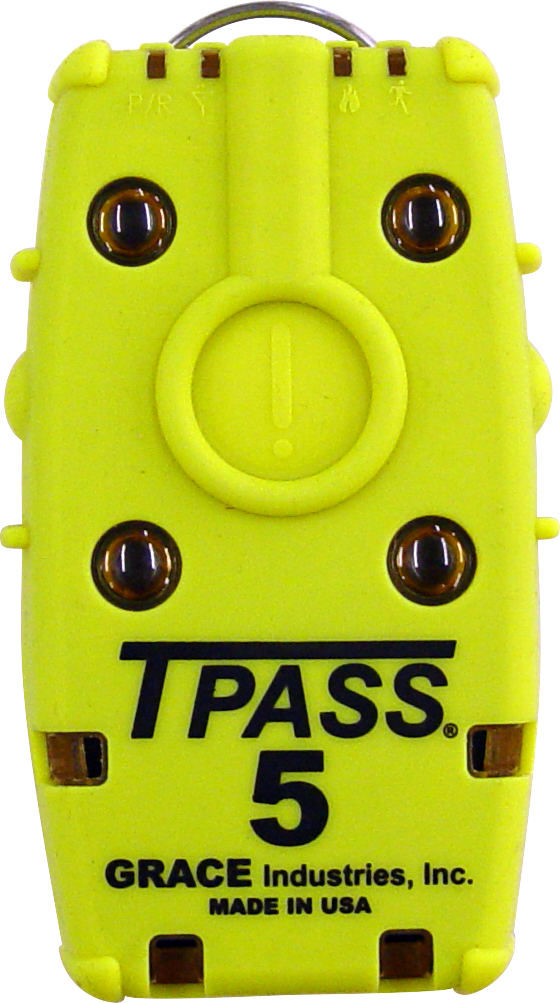
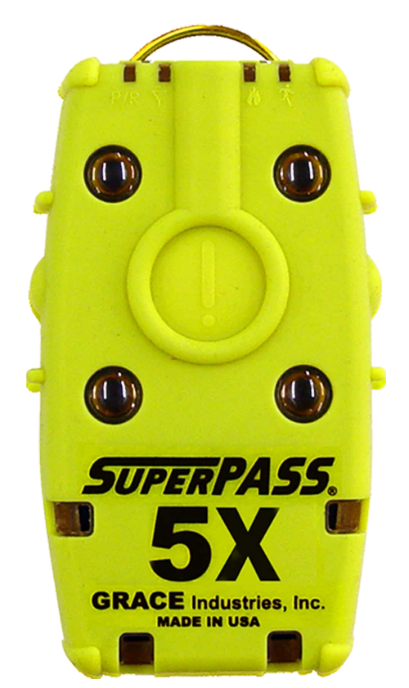
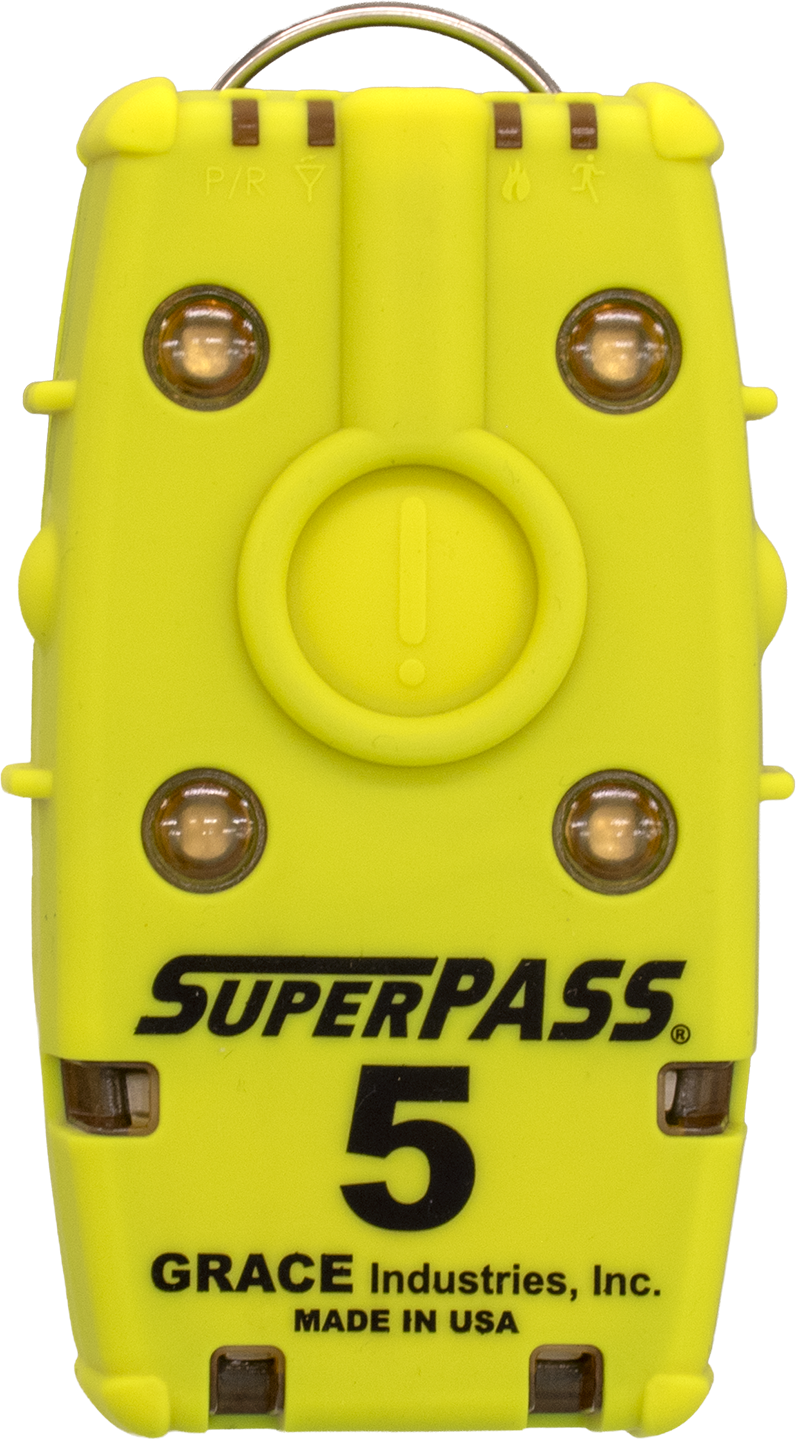
Grace Industries has been protecting those who protect us for over 50 years. Our SuperPASS® 5, SuperPASS® 5X and TPASS® 5 standalone PASS devices meet and exceed NFPA 1970 (2025 ed.). To talk through what the consolidation means for your fleet or your next purchase specification, visit graceindustries.com or contact us at 724-962-9231 or at sales@graceindustries.com.
This article is general information, not legal advice. It was drafted with the assistance of AI which can make mistakes. Requirements should be confirmed against a licensed copy of NFPA 1970 (2025 ed.) and the regulations in force in your jurisdiction.
Next step
Writing a specification? Get the certification details in writing.
We can provide NFPA 1970 (2025 ed.) compliance documentation, hazardous-location certification details, and specification language for your next purchase or grant narrative — no obligation.