
Fire Service Funding
Funding PASS Devices Through Federal Fire Grants
A PASS is Tier 1 PPE inside a turnout gear ensemble under AFG — and an explicitly authorized purchase under seven other federal grant programs most fire departments never look at. Here’s the full funding landscape and what makes an application competitive.
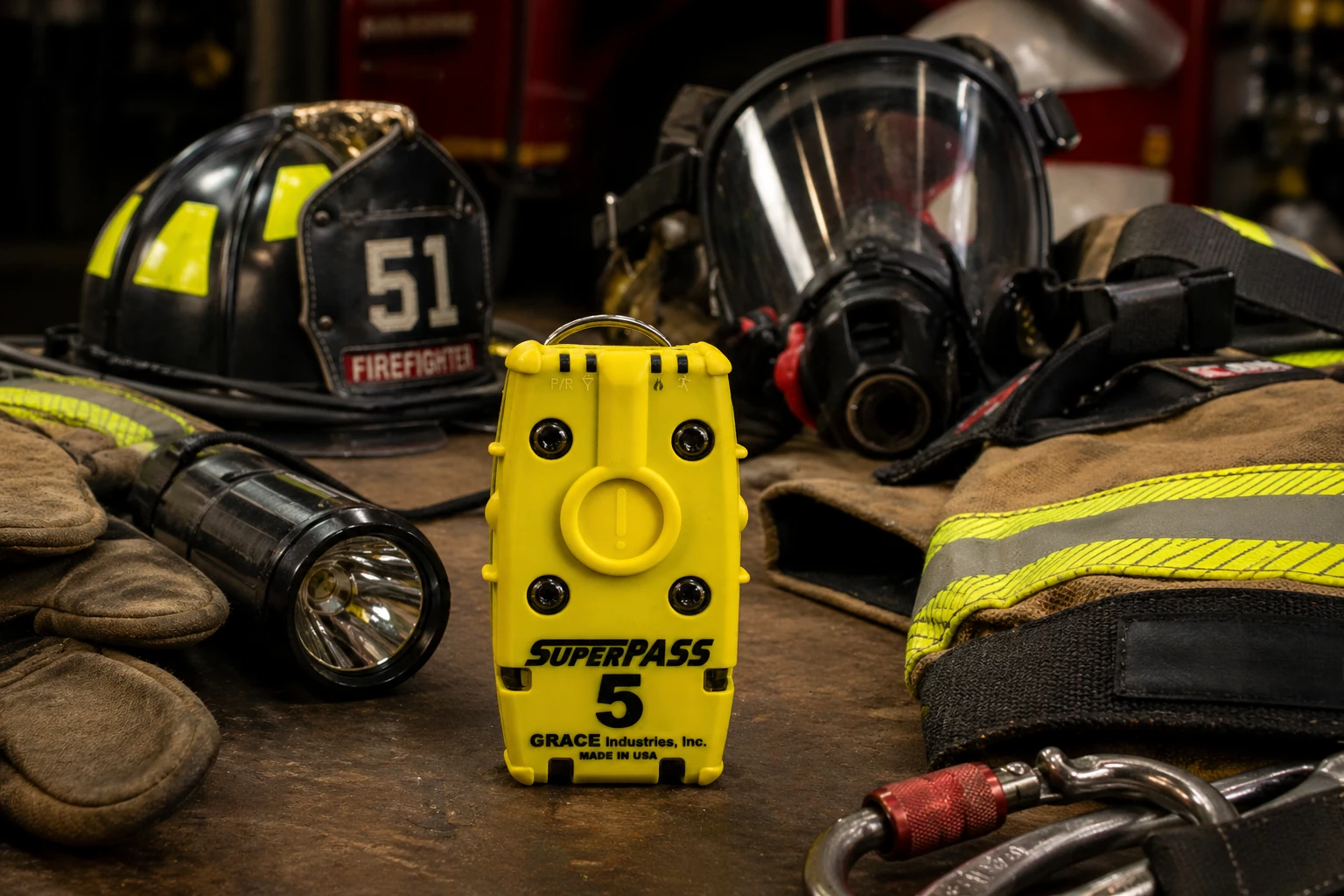
A standalone PASS runs roughly $600 to $950 per firefighter. For a career department, that’s a line item. For a volunteer department covering a rural township on a fundraising budget, it can be the difference between equipping everyone and equipping no one.
Grants are how most volunteer departments close that gap. Here’s what’s available — including several federal programs that name PASS devices explicitly and that most fire departments never look at — what each will and won’t cover, and what separates a funded application from a rejected one.
Assistance to Firefighters Grant (AFG) — the primary path
AFG is the program. It’s FEMA’s direct-to-department equipment and safety grant, and it’s the one most PASS purchases will run through.
Current status
The program is authorized and funded through fiscal year 2028, with the sunset extended to September 30, 2030 by the Fire Grants and Safety Act (Public Law 118-67), signed July 9, 2024. That law authorizes $750 million per year for the firefighter assistance grant programs for FY2024 through FY2028, plus $95 million for the U.S. Fire Administration.
The FY 2025 cycle opened May 19, 2026 and closed June 22, 2026 — a 34-day window. DHS made $648 million available across AFG, SAFER and FP&S, with $291.6 million to AFG and approximately 1,800 anticipated awards.
Two things worth noticing about that. First, the cycle runs well behind its fiscal year label and the timing has drifted — FY2024’s window was November–December 2024; FY2025’s was May–June 2026. Do not assume a predictable annual date. Monitor fema.gov/grants/preparedness/firefighters rather than planning around last year’s calendar.
Second, and this is new: for the first time in the program’s history, SAFER’s allocation ($324M) exceeds AFG’s. Equipment money is under pressure.
Who can apply
Fire departments; nonaffiliated EMS organizations; State Fire Training Academies; and qualifying non-federal airport or port authority fire and EMS organizations — across all 50 states, the territories, and federally recognized tribal governments.
Cost share
Straight from the FY25 Notice of Funding Opportunity (NOFO), by population served:
| Population served | Applicant cost share |
|---|---|
| 20,000 or fewer | 5% |
| 20,001 to 1,000,000 | 10% |
| Over 1,000,000 | 15% |
You’ll see 10% and 25% figures circulating in vendor blog posts. The NOFO controls; use these.
Maximum awards
| Population served | Maximum |
|---|---|
| ≤100,000 | $1 million |
| 100,001–500,000 | $2 million |
| 500,001–1,000,000 | $2.91 million |
| >1,000,000 | $2.91 million, waivable to $9 million |
Are PASS devices eligible? Yes — as PPE. Here’s the precise framing.
This deserves care, because the answer is solid but the reasoning matters if you’re writing a narrative.
What’s confirmed:
- PPE is squarely eligible under AFG’s Operations and Safety activity category. The FY25 NOFO’s stated program objective includes “outfit responders with compliant personal protective equipment to increase responders’ physical protection,” and its performance metric is the “percentage of active-duty members equipped with National Fire Protection Association (NFPA) and Occupational Safety and Health Administration (OSHA)-compliant personal protective equipment.”
- A FY 2025 change worth knowing: PPE and SCBA replacement is now allowed regardless of age, removing the effective gate that previously tied replacement to equipment age and NFPA cycles.
- PASS devices are a named, tiered item in AFG’s own funding priorities — see the ensemble section immediately below, which is the part that actually decides applications.
What’s worth being straight about: the AFG NOFO does not name PASS devices, “personal alert safety system,” or NFPA 1970/1982 anywhere in its running text. It speaks about PPE at the category level, and the detail lives in the funding priority guidance rather than the NOFO body.
So the correct framing for your narrative: a PASS is firefighter PPE governed by an NFPA standard — formerly NFPA 1982, now consolidated into NFPA 1970 (2025 edition). AFG’s Operations and Safety category exists to equip responders with NFPA- and OSHA-compliant PPE. Write the request as a PPE request, cite the standard, and build it around the ensemble.
And here is the part that decides whether you get funded
A PASS device counts as Tier 1 PPE when it is requested as part of a turnout gear ensemble.
That distinction is worth more than everything else on this page, because AFG has in recent years been able to fund essentially only its highest-priority items. A request that sits in the top tier is in the running. A request that doesn’t, generally isn’t.
The ensemble, as AFG defines it, is:
a helmet · two hoods · a coat · pants · two sets of gloves · boots · suspenders · goggles · and a PASS device
Read that list again and notice what it is doing. It is not a shopping list — it is a description of one firefighter, fully outfitted. The PASS is a named component of a complete structural firefighting ensemble, and it is funded on that basis.
The practical consequence for how you write the request:
- Requesting a complete or partial turnout ensemble that includes PASS devices puts the PASS in the top priority tier along with everything else in the ensemble.
- Requesting PASS devices on their own, disconnected from the ensemble, is a different and weaker proposition — you are asking for one accessory rather than to outfit firefighters.
If your department needs PASS devices and also needs gear, that is not two applications. It is one ensemble request, and the PASS belongs inside it.
If your department needs only PASS devices because the rest of the gear is current, you can still make the case — but make it explicitly as completing the ensemble. Say which components your firefighters already have, say that the PASS is the missing element of an otherwise compliant ensemble, and tie it to NFPA 1970 (2025 ed.). The reviewer needs to see a fully outfitted firefighter at the end of your request.
Priority tiers are set per funding cycle by FEMA’s Criteria Development Panel and can change. Confirm the current NOFO’s funding priority matrix before you build an application around any of this.
Priority versus need — the distinction that decides applications
This is the single most useful thing to understand about AFG, and most first-time applicants don’t.
FEMA’s Criteria Development Panel assigns high, medium or low priority to project types within each category, published as a matrix in the NOFO. And the practical reality, stated bluntly in industry guidance: “With decreased funding in recent years, the AFG program has only been able to fund high-priority projects.”
Priority is FEMA’s ranking. Need is what you demonstrate. Both are required, and they do different work. As one long-running AFG guidance source puts it: “The ‘need’ part of the equation is described by the grant applicant, and it is the determining factor if your application for a priority item stands any chance of being funded.”
A related trap: applications that mix priority tiers may be negatively impacted. A tightly scoped request generally beats a shopping list.
But notice how that interacts with the ensemble point above, because it is easy to draw the wrong conclusion from it. A turnout gear ensemble is not a shopping list — it is a single item at a single priority tier that happens to have ten components. Bundling a PASS into an ensemble request is not mixing tiers; it is putting the PASS in the right one. What hurts you is combining, say, an ensemble request with a vehicle exhaust system and a training package in the same application.
Check the funding priority matrix in the current NOFO before you build your application. Tiers are set per cycle and can change. That’s a ten-minute check that determines whether the application is worth the effort.
How applications are scored, and why they fail
Final score = 50% electronic pre-score + 50% peer review. At peer review, four narrative elements are scored equally at 25% each:
- Financial Need
- Project Description / Budget
- Cost Benefit
- Statement of Effect on Operations
Applications that clear the automated pre-score go to independent peer panels, with three reviewers per application across roughly 9,000 applications per cycle.
Rejections come in three distinct flavors, and the wording of the notice tells you which one applies to your application:
- Pre-score rejection — the applicant isn’t eligible, the requested items don’t align with funding priorities, budget figures exceed industry standards, or the Request Details narratives don’t match program goals. The notice says the application “did not score high enough to receive further consideration through the panel review process.”
- Peer review dismissal — you advanced, but the narratives “lacked sufficient clarity and supporting data for competitive scoring.”
- Funding shortfall — you passed peer review but higher-scoring applications took the money.
Those are three different problems with three different fixes. Type 1 means rethink what you’re asking for. Type 2 means rewrite. Type 3 means apply again.
What reviewers reward
Narrative detail, call volume, population served, and — importantly for this request — demonstrated NFPA-standards compliance. A department that ties its request to a specific standard requirement and a documented risk assessment scores better than one asserting general need.
For a PASS application, that gives you unusually good material:
- NFPA 1970 (2025 ed.) as the current product standard, with the note that new product is certified to it and 2018-edition PASS could no longer be shipped after March 2026
- NFPA 1550 (2024 ed.) personnel accountability requirements, which consolidated the former NFPA 1500, 1521 and 1561
- NFPA 1710 requirements for initial rapid intervention crews and full RIC establishment
- Your own NIOSH-informed risk assessment — LODD investigations repeatedly cite communications and accountability failures as contributing factors
First-time applicants do best with a tightly scoped application targeting a single equipment category rather than a multi-activity proposal.
The other federal programs
SAFER — staffing, with one narrow equipment path
$324 million in FY2025. Two activities only: Hiring of Firefighters and Recruitment and Retention.
Equipment, PPE, apparatus and gear are not eligible as standalone purchases. But there’s one real path: PPE is eligible under SAFER as a component of a Recruitment and Retention activity — specifically “Personal Protective Equipment for new recruits.”
For a volunteer department running an R&R application, outfitting new recruits with PASS is a legitimate line. It’s narrow, but it’s real.
Periods of performance: hiring is 36 months plus a 180-day recruitment period; R&R is 12, 24, 36 or 48 months plus a 90-day recruitment period.
FP&S — research, not hardware
$32.4 million in FY2025, in two categories: activities to reach high-risk target groups and mitigate fire death and injury, and research and development aimed at improving firefighter safety.
Eligible applicants are broader than AFG, uniquely including public and private institutions of higher education for the R&D activity.
FP&S is generally not a channel for buying PASS hardware for a department. It is a channel for research — potentially relevant if a department partners with a university on accountability-technology effectiveness research, which is a different conversation.
Beyond AFG
The seven DHS preparedness grants that name PASS devices explicitly
This is the path almost nobody in the fire service thinks about, and PASS devices are named in it by number.
FEMA’s Authorized Equipment List is the equipment catalogue that governs the Department of Homeland Security’s preparedness grant programs. PASS devices have their own entry:
AEL 01ZA-01-PASS — “System, Personal Alert Safety (PASS), NFPA 1970 (1982)” “PASS Device — personal alert safety system (certified as compliant with the NFPA 1982 requirements of NFPA 1970).”
Two things about that entry are worth noticing before anything else.
First, FEMA has already updated its own catalogue to the consolidated standard. The item is titled to NFPA 1970, with NFPA 1982 in parentheses as the legacy reference. If you needed a reason to specify NFPA 1970 (2025 ed.) in a purchase document, the federal equipment list is already written that way.
Second — and this is the part that opens a door — the entry lists the FEMA grant programs it applies to:
| Program | Who administers it |
|---|---|
| Emergency Management Performance Grants (EMPG) | Your state emergency management agency |
| State Homeland Security Program (SHSP) | Your State Administrative Agency |
| Urban Area Security Initiative (UASI) | Designated urban area, via the SAA |
| Tribal Homeland Security Grant Program (THSGP) | Federally recognized tribes, direct |
| Port Security Grant Program (PSGP) | Port authorities and port-area responders |
| Transit Security Grant Program (TSGP) | Transit agencies and their responders |
| Intercity Passenger Rail (IPR) | Rail operators and responders |
What this means practically. These are not fire grants, and they do not come from the AFG pot — which is the point. They are a separate, differently-competed pool of money, and PASS devices are an explicitly authorized purchase under all seven.
For most municipal and volunteer departments the realistic entries are EMPG and SHSP, both of which flow through a state agency rather than direct application to FEMA. That changes the work: instead of a 9,000-application national peer review, you are talking to your state emergency management agency or State Administrative Agency about their allocation and their process. Smaller field, different gatekeeper, and a conversation most fire departments have never had.
If your department serves a port, a transit system, a rail corridor, or is a tribal department, look at PSGP, TSGP, IPR and THSGP specifically. Those programs are smaller and far less contested than AFG, and the AEL puts PASS devices squarely inside them.
One caution, and it matters. The AEL governs these DHS preparedness programs. It does not govern AFG — AFG, SAFER and FP&S are not on the entry’s program list, and AFG runs its eligibility through its own NOFO and application Request Details instead. So do not cite the AEL in an AFG narrative; it is the wrong authority for that program. Use it where it applies, which is the seven programs above.
Volunteer Fire Assistance (VFA) — arguably the best fit for a PASS purchase
Federal funds administered through state forestry agencies under a USDA Forest Service program. Eligible items include PPE, tools and equipment for rural volunteer fire departments.
Rules and caps vary by state and you must check yours. Virginia’s program, as one example, runs a 50/50 match and states it “is not allowed to provide full or partial grant funding for any one piece of equipment over $5,000 in cost.”
Read that constraint again in the context of a PASS purchase. A per-item cap that rules out an apparatus or an SCBA fleet does not rule out PASS devices at all. VFA is small-dollar, PPE-eligible, matched, and aimed at exactly the small rural volunteer departments least likely to have integrated PASS on their air packs. For many departments it’s a faster and more winnable path than AFG.
Apply through your state forestry agency’s grant portal. A UEI number is required.
USDA Rural Development — Community Facilities
For rural areas of 20,000 or fewer residents. Eligible uses explicitly include “public safety services such as fire departments, police stations, prisons, police vehicles, fire trucks, public works vehicles or equipment.”
Grants cover up to 75% of eligible costs on a graduated scale driven by population and median household income — the 75% maximum requires population ≤5,000 and median household income below the poverty line or below 60% of the state nonmetropolitan median. Direct loans run up to 40-year terms with no prepayment penalty.
Private and foundation grants
Firehouse Subs Public Safety Foundation runs quarterly cycles with a maximum request around $40,000, capped at 600 applications per quarter, fully digital. Departments must wait three years to reapply after an award. Because the cycle is quarterly rather than annual, it’s often the fastest path to a modest equipment purchase.
Gary Sinise Foundation — First Responders Outreach funds equipment and training only, explicitly excluding operational costs. PPE qualifies. Priority goes to volunteer and underfunded departments. One application per department per calendar year regardless of prior outcome.
FM Fire Prevention Grant Program funds fire prevention, preparedness and control efforts including pre-incident planning, fire prevention education and training, and arson prevention and fire investigation. Its published scope reads prevention- and education-oriented; confirm directly with FM before treating it as a response-PPE channel.
Practical advice
- Check the priority matrix before you write. Ten minutes in the current NOFO’s funding priority appendix tells you whether your request is in a tier that gets funded.
- Write the request as PPE and cite the standard. NFPA 1970 (2025 ed.) is the current PASS standard. Naming it, and explaining what your current equipment is certified to, does real work in both the Project Description and the Statement of Effect.
- Bundle the PASS into an ensemble request, not a standalone one. A PASS is Tier 1 PPE as part of a turnout gear ensemble. Requesting one component in isolation is a weaker proposition than requesting to outfit a firefighter.
- Scope it tightly — but remember an ensemble is one item, not ten. One category per application. Reviewers reward focus, and mixing priority tiers hurts you; bundling the ten components of a single ensemble does not.
- Put the work into Financial Need and Cost Benefit. They’re 25% each — half your peer review score — and they’re the sections departments most often rush.
- Don’t run only one application. VFA through your state forestry agency, a quarterly Firehouse Subs application, and a Gary Sinise application are all separate shots at the same purchase, with different competition and different timelines.
- Read the rejection letter carefully if you don’t get funded. Whether it’s a pre-score rejection, a peer review dismissal, or a funding shortfall tells you exactly what to do differently — and they’re three different fixes.
- If you’re buying anyway, consider the upgrade path. A device that starts as a compliant standalone PASS and later converts to a telemetry PASS with a field software upgrade means a grant-funded purchase today doesn’t have to be re-purchased when accountability capability becomes affordable. That’s a legitimate cost-benefit argument in the narrative, not just a product feature.
Frequently asked questions
Are PASS devices eligible for AFG funding?
Yes, as personal protective equipment under the Operations and Safety activity category. AFG’s stated objective includes outfitting responders with NFPA- and OSHA-compliant PPE, and FEMA maintains a dedicated Authorized Equipment List item for PASS (01ZA-01-PASS) in the PPE section. Write the request as a PPE request and cite the applicable NFPA standard.
What priority tier are PASS devices?
A PASS device is Tier 1 PPE when requested as part of a turnout gear ensemble — defined as a helmet, two hoods, a coat, pants, two sets of gloves, boots, suspenders, goggles and a PASS device. That matters because AFG has in recent years been able to fund essentially only its highest-priority items. Build the request around outfitting firefighters rather than around one accessory. Tiers are set per cycle, so confirm against the current NOFO’s funding priority matrix.
Can I apply for PASS devices alone if our turnout gear is current?
You can, but frame it as completing the ensemble rather than as a standalone accessory purchase. State which ensemble components your firefighters already have, identify the PASS as the missing element of an otherwise compliant ensemble, and tie it to NFPA 1970 (2025 ed.). The reviewer should finish your narrative picturing a fully outfitted firefighter.
What is the cost share for AFG?
5% for jurisdictions serving 20,000 residents or fewer, 10% for 20,001 up to 1,000,000, and 15% for over 1,000,000.
Can SAFER pay for PASS devices?
Not as a standalone purchase. SAFER funds hiring and recruitment and retention only. PPE is eligible under SAFER solely as a component of a Recruitment and Retention activity — “personal protective equipment for new recruits.”
When is the next AFG application window?
FEMA has not announced one at the time of writing. The FY2025 window ran May 19 to June 22, 2026, and the cycle timing has drifted significantly between years, so don’t plan around a fixed annual date. Monitor fema.gov/grants/preparedness/firefighters, or contact the AFG Help Desk at firegrants@fema.dhs.gov or 1-866-274-0960.
Are PASS devices on FEMA’s Authorized Equipment List?
Yes — AEL item 01ZA-01-PASS, “System, Personal Alert Safety (PASS), NFPA 1970 (1982).” But read the fine print on which programs it covers: the entry lists EMPG, SHSP, UASI, THSGP, PSGP, TSGP and IPR. AFG, SAFER and FP&S are not on that list. The AEL governs DHS preparedness grants; AFG runs eligibility through its own NOFO. So the AEL is a genuine funding path — just not an argument to put in an AFG narrative.
What’s the best grant for a small volunteer department?
Volunteer Fire Assistance through your state forestry agency is often the best fit for a PASS purchase specifically — it’s PPE-eligible, matched (commonly 50/50), and its typical per-item caps rule out apparatus but not personal equipment. It’s also less competitive than AFG. Firehouse Subs and Gary Sinise Foundation grants are worth running in parallel.
Why do AFG applications get rejected?
Three distinct reasons, and the notice language identifies which one applies: failing the automated pre-score (ineligibility, misalignment with funding priorities, or budget figures outside industry standards), being dismissed at peer review for narratives lacking clarity and supporting data, or passing peer review but losing out to higher-scoring applications.
Does citing NFPA compliance help an application?
Yes. Reviewers assess narrative detail, call volume, population served and NFPA-standards compliance. Tying the request to a specific standard requirement and a documented risk assessment is materially stronger than asserting general need.
About Grace Industries
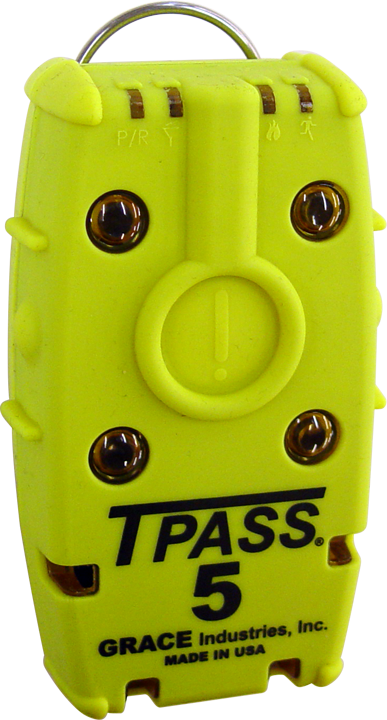
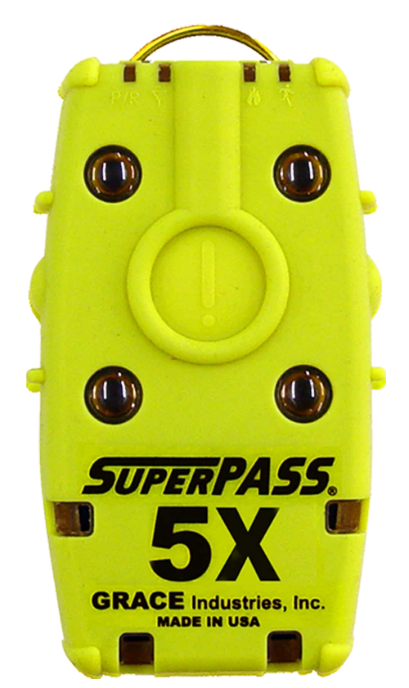
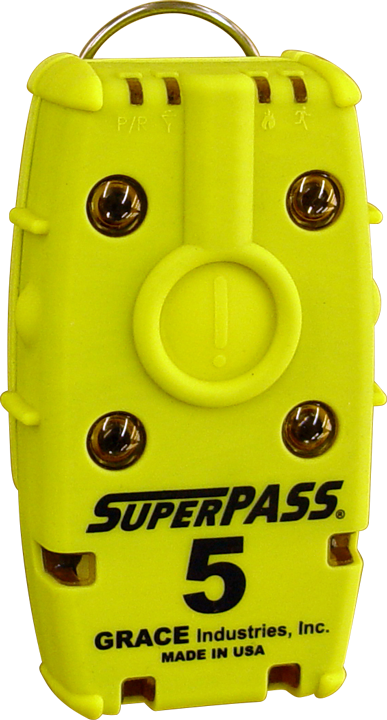
Grace Industries has been protecting those who protect us for over 50 years. Our SuperPASS® 5, SuperPASS® 5X and TPASS® 5 standalone PASS devices meet and exceed NFPA 1970 (2025 ed.), and the SuperPASS® 5X converts to a full telemetry TPASS® 5 with a field software upgrade — so a grant-funded purchase today doesn’t have to be repurchased tomorrow. For specification language, pricing documentation for your budget narrative, or help scoping a request, visit graceindustries.com or contact us at 724-962-9231 or at sales@graceindustries.com.
This article is general information, not legal advice. It was drafted with the assistance of AI which can make mistakes.
Next step
Building a grant application? We’ll help you scope it.
We can provide specification language, NFPA 1970 (2025 ed.) compliance documentation, and pricing documentation for your budget narrative — no obligation.